
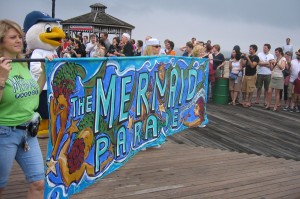
 Having been a Brooklynite for most of my life, including my childhood, I’m surprised that I never stepped out to experience Coney Island’s annual Mermaid Parade until this year. I’ve been a part of the Coney Island community when I attended middle school in the area and worked as a docent at the New York Aquarium for a few years while I was in high school. The Coney Island beach was always the first place I’d visit when summer finally arrives. However, out of all of those memories, I believe that being a part of the Mermaid Parade tradition is the most meaningful of all. It’s still a major reason why people from all over the U.S. visit Coney Island at this time of year and joyful reminder of why Coney Island should be preserved. Everyone from the community either joins in on the parade or camps out along the boardwalk to see the spectacle.
Although this is my first time at the parade, I worked as a volunteer. My high school friend convinced me to go and volunteer together, so both of us were assigned to stand on the boardwalk in front of Nathan’s original hot dog stand at Stillwell Avenue. We brought our DSLR’s and each shot close to 1000 photos that day. The parade featured a family section and an artistic section; the latter is just an euphemism for the section of people who may be marching in the nude. That’s one of the greatest thing about this parade. It’s not only a celebration of the long-awaited summer, but also a chance for the community and non-residential Coney Island lovers to liberate themselves using the aquatic theme. The women are usually dressed as mermaids, whereas the men go as pirates or sailors; plenty of men and women switched gender roles. Many other marine creatures, both real and fictional, got represented as well. We didn’t get to see a major part of the parade, which were the floats and the old-fashioned cars. They weren’t allowed to drive onto the boardwalk. Otherwise, we had an amazing time interacting with the parade participants and cheering them on.
After the parade, we strolled down the streets of vendors and watched the setting sun. I asked my friend why he always speaks of Coney Island so passionately, and frequently came here whenever he visited his home in Staten Island. He said that Coney Island was his happy place; whenever he was sad or unhappy, he’ll just think of Coney Island to cheer himself up. That made sense to me and made me realize that Coney Island was more than just an amusement park on the cheap. It represented a community and decades of tradition that I hope will survive through the massive commercial changes taking place over the next few years.